Your child will get the first case wrong.That is the design.
Ten detective cases where the obvious answer is built to collapse on the very next page — and where being wrong, safely, on paper, is the thing that teaches the habit.
167 illustrated pages · The Dinner Table Deck included · Yours to print at home
- Ages 7–12
- 25 minutes a case
- No screen needed
- Instant download
- ✓An illustration on every page — 98 in all
- ✓Write-in space before every reveal
- ✓A print-at-home black-and-white edition of all 167 pages
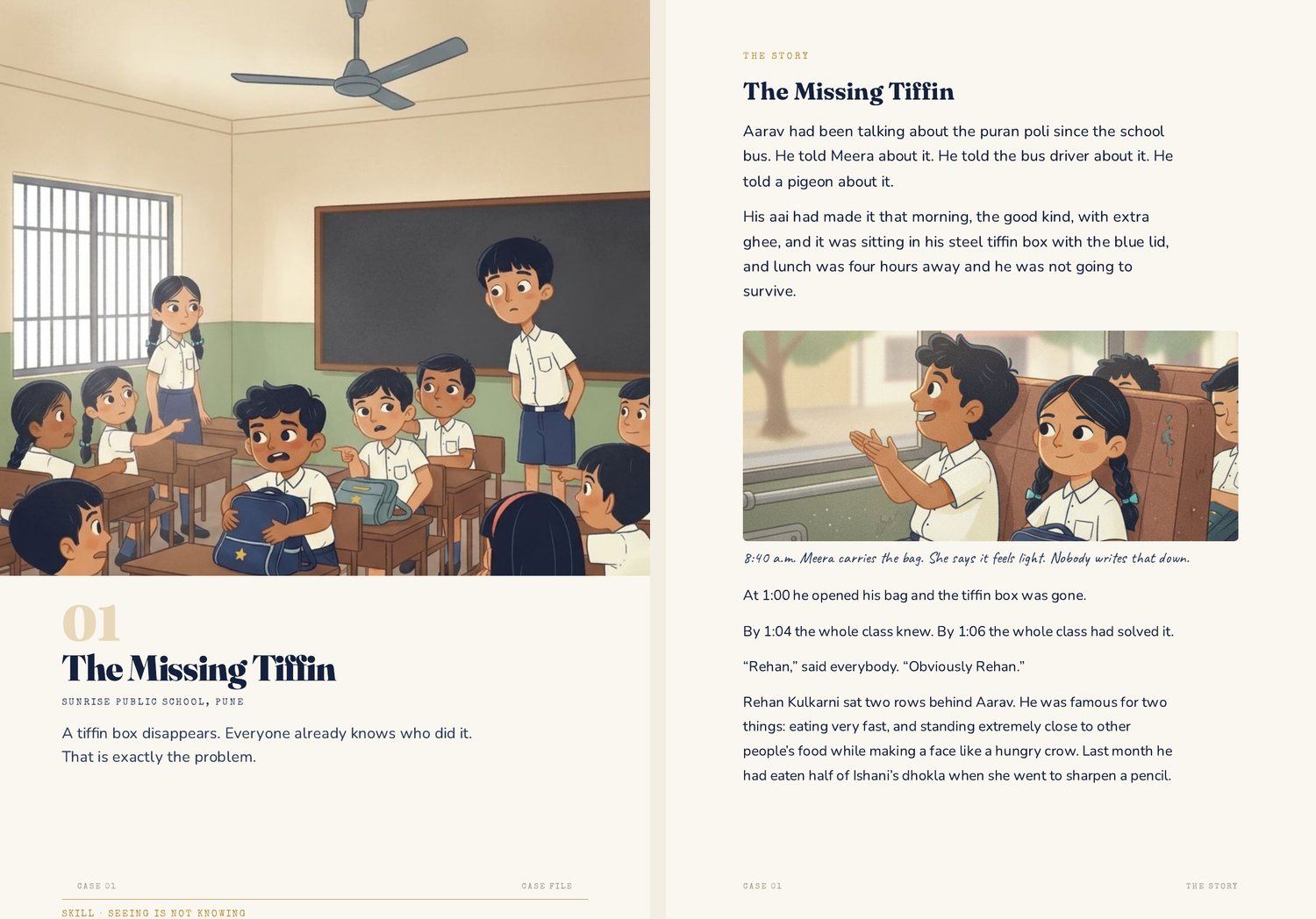
Why this book exists
Nobody in these stories is lying.
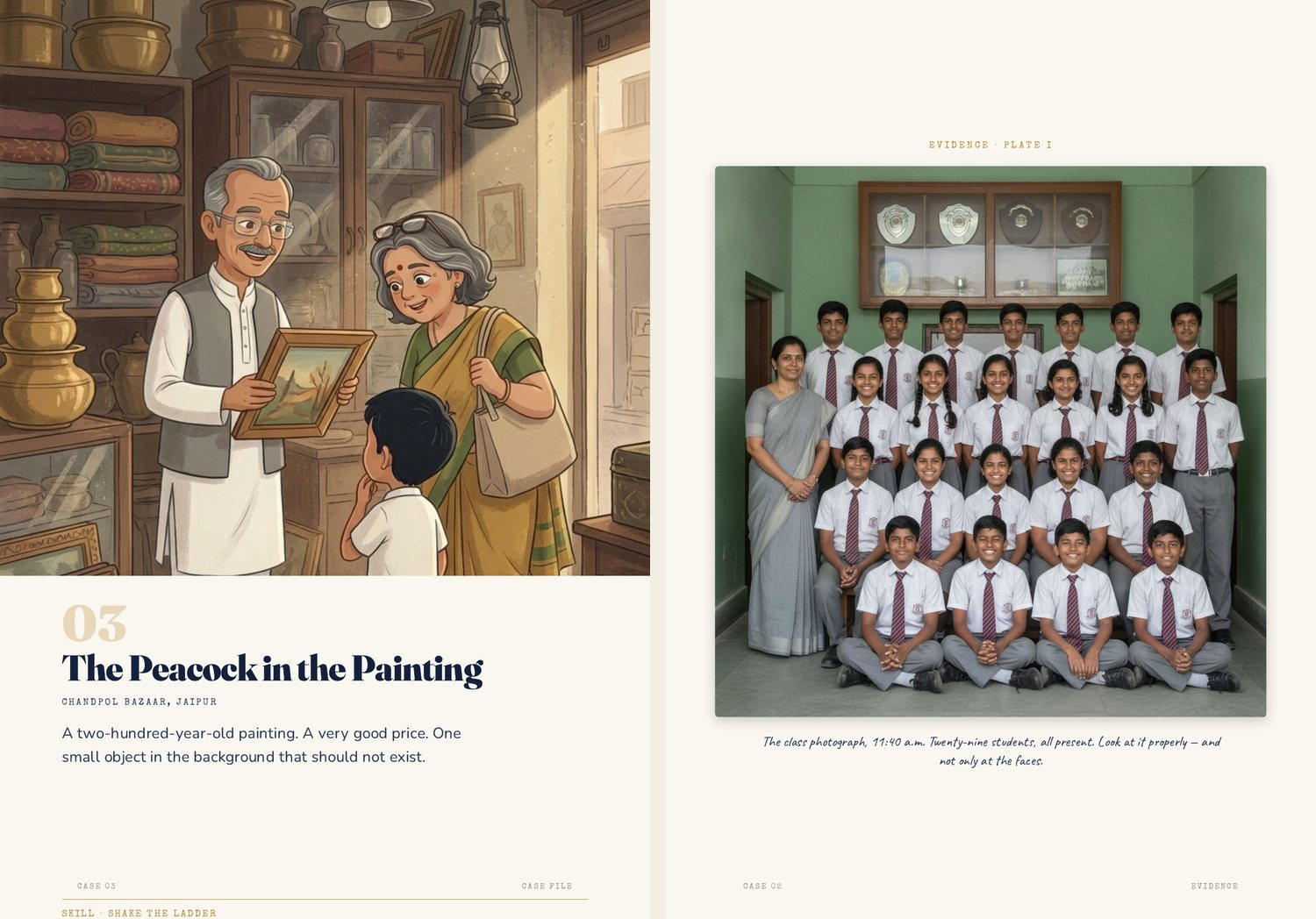
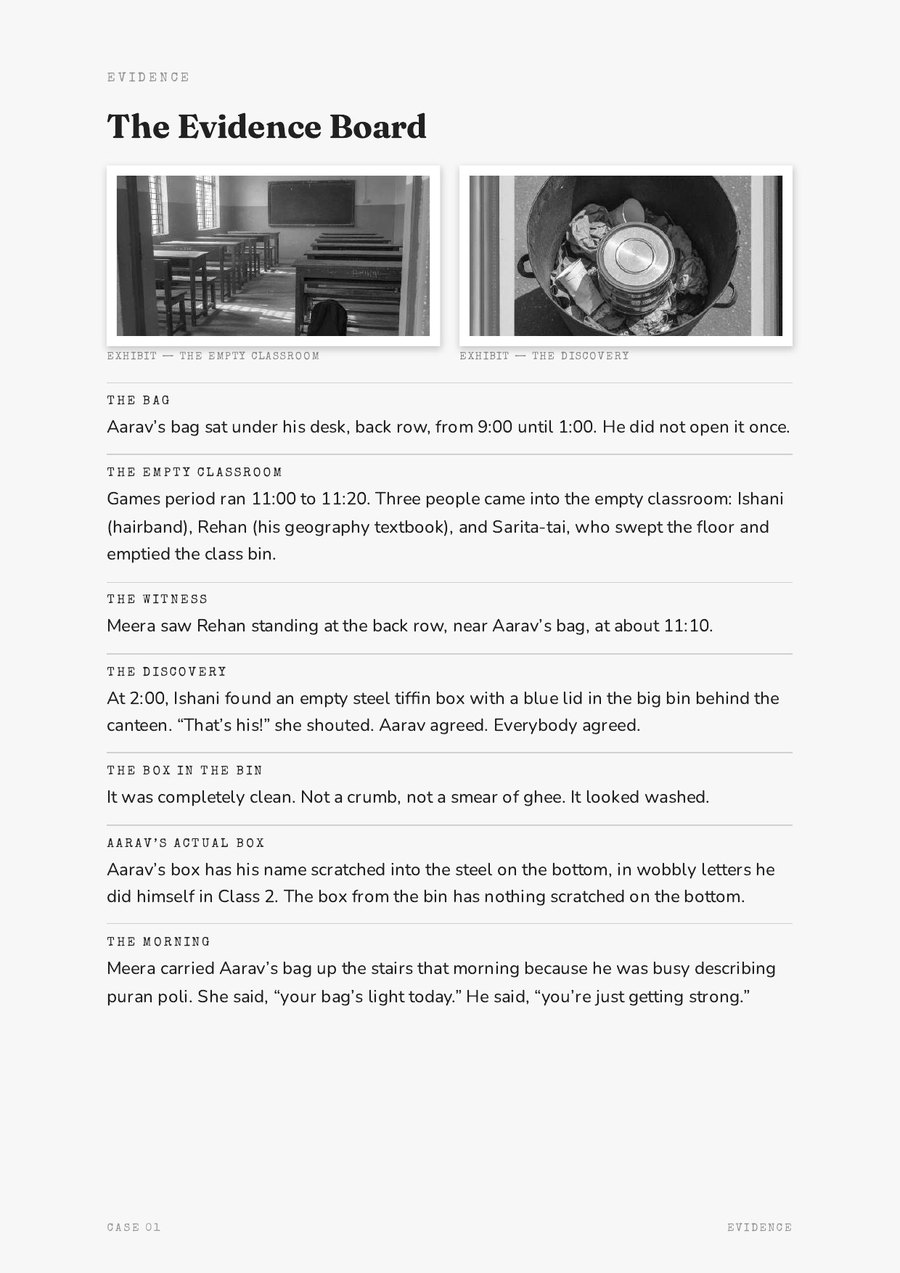
That is what makes them hard. A tiffin box everyone agrees was stolen. A photograph that gives twenty-nine children an alibi and quietly destroys the whole case. Every witness is honest. Every child is sure. And almost every one of them is wrong.
Because the mistake your child needs to catch is not somebody lying to them. It is the gap between what they saw and what they decided — and no amount of being told about that gap has ever taught anyone to see it.
How one case works
Three pages do all the work.
Every case is built the same way, and your child does all of it alone.
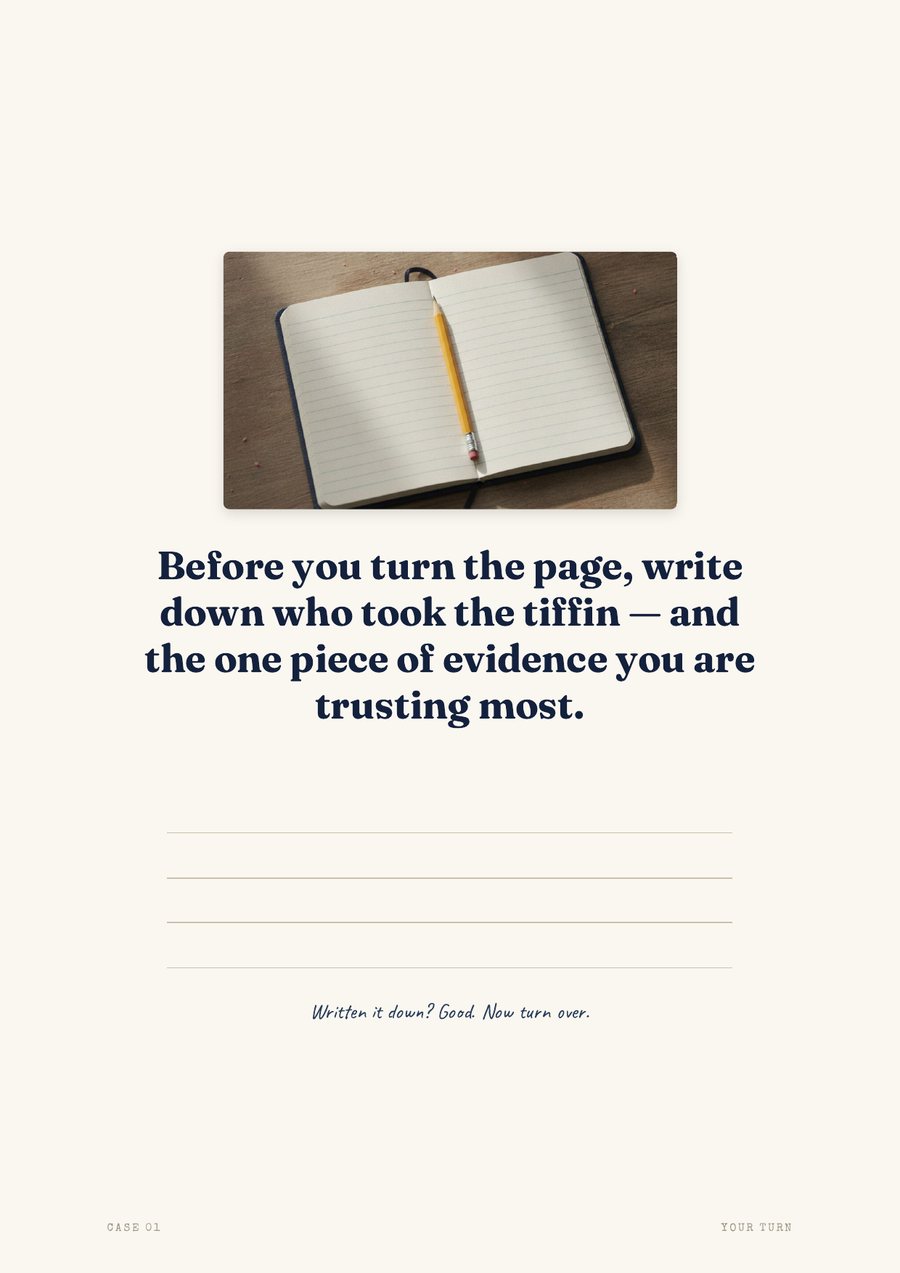
The case stops. Before any reveal, your child has to write down who did it — and which single piece of evidence they are trusting.
In pen. That is the part that matters. A guess you keep in your head can be quietly edited later. A guess in your own handwriting cannot.
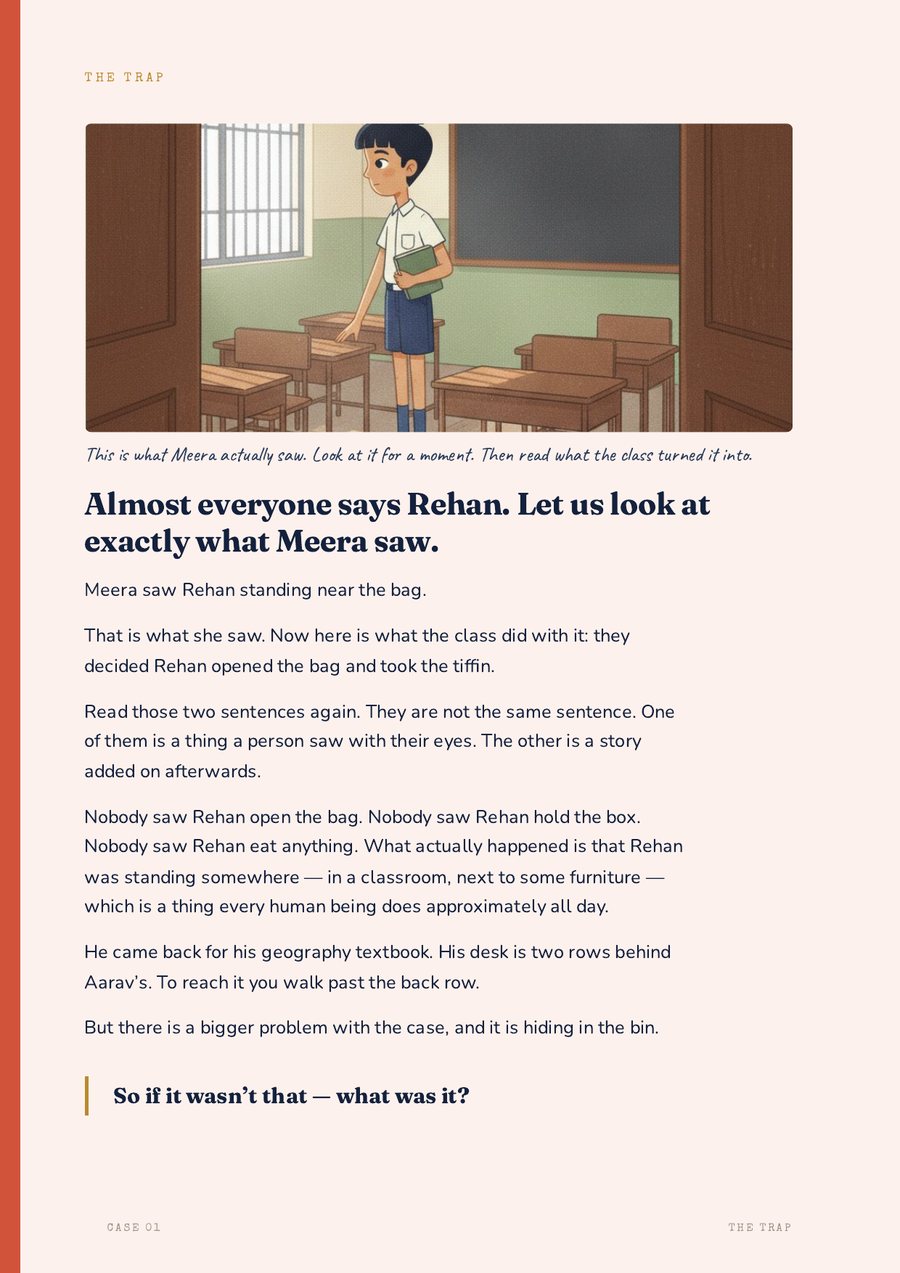
Turn over, and the book tells them the truth: almost everyone says Rehan. Then it walks through exactly what Meera actually saw, and where her eyes stopped and her opinion started.
Not just the right answer. The step in their own reasoning that failed.
After a few of those, something shifts. They stop answering instantly. They start asking which part they actually saw.
That is the whole product. Ten chances to be confidently wrong where it costs nothing — so that being confidently wrong somewhere it matters becomes less likely.
Look inside before you decide
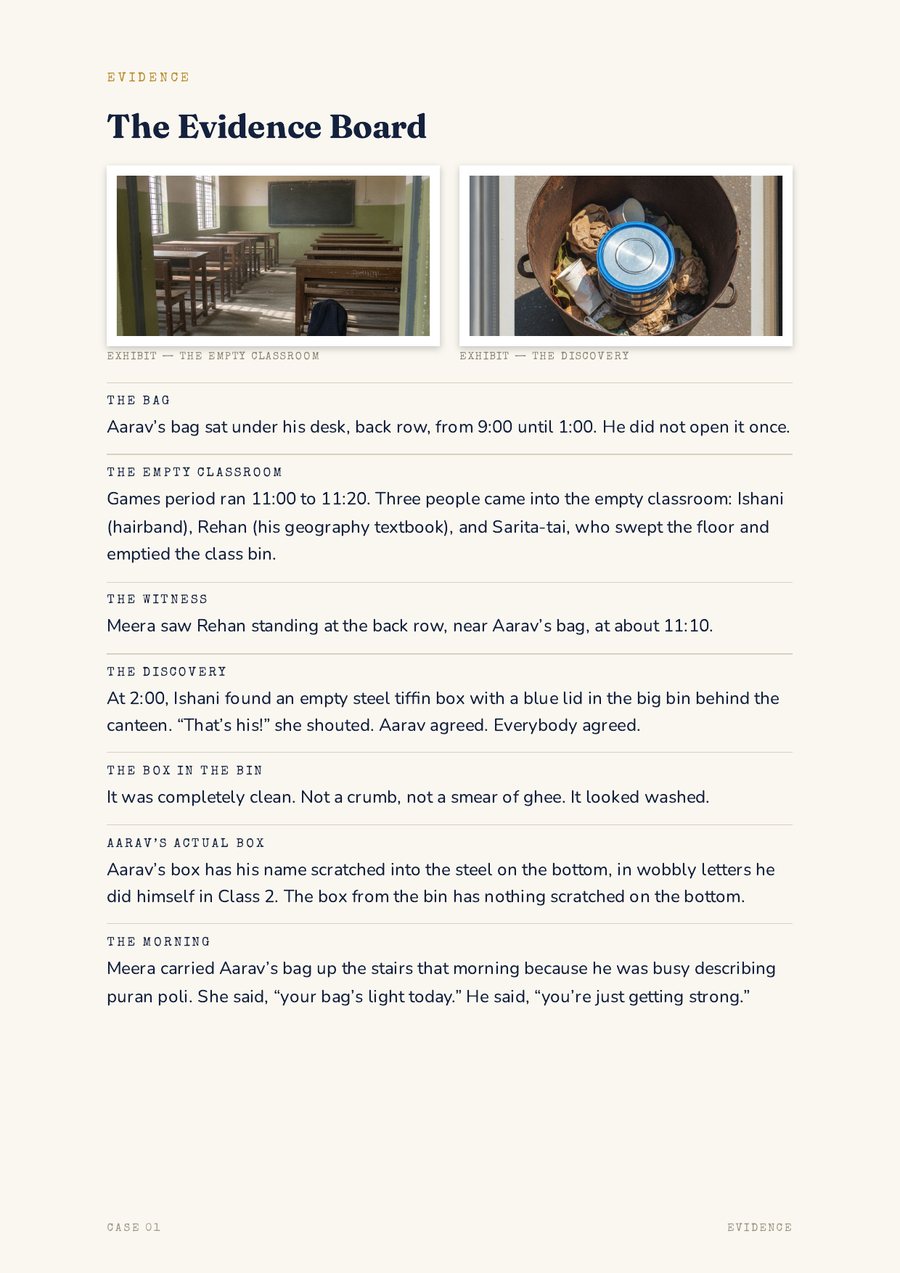
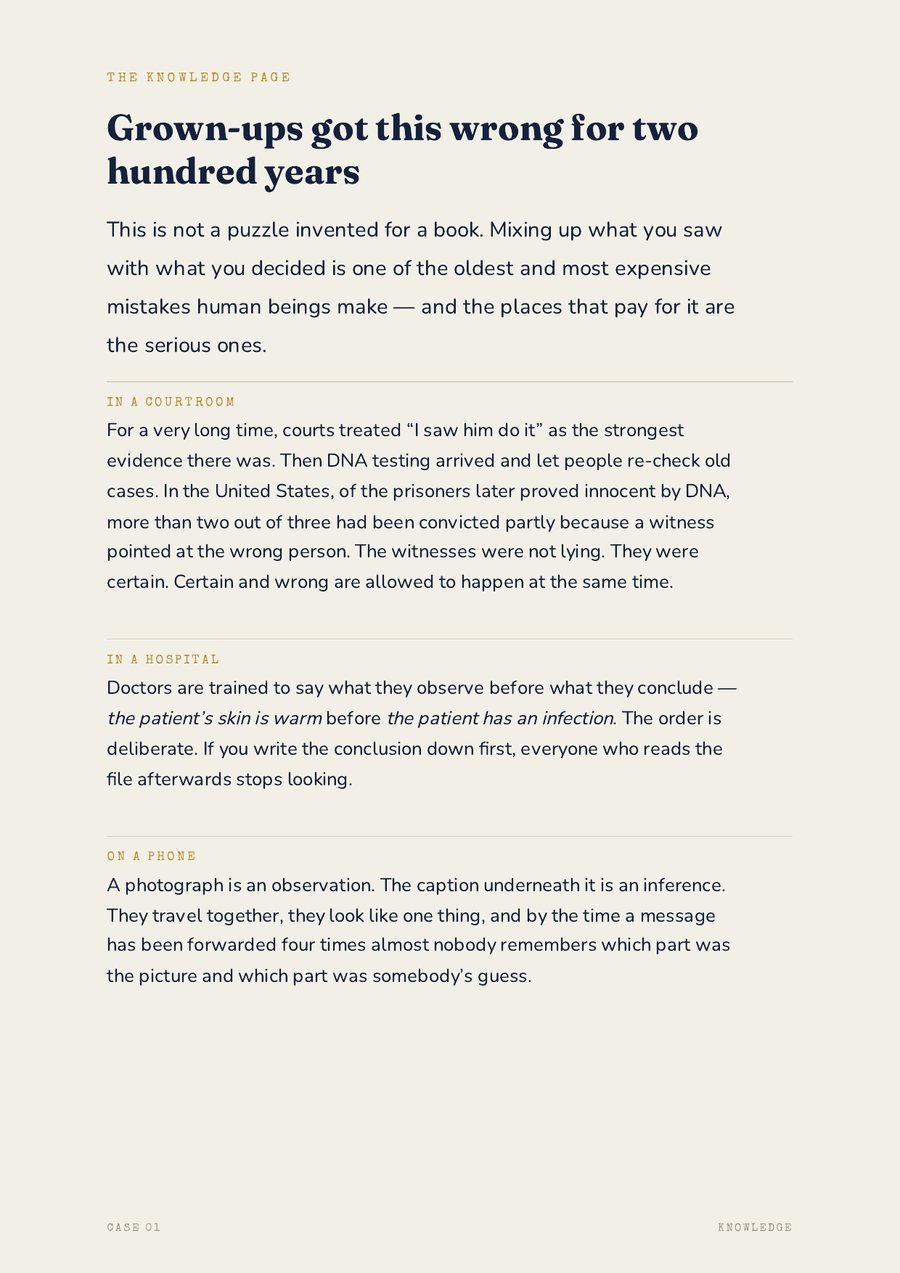
These are real pages, not mock-ups.
Every image below is a page straight out of the book you will receive. Read them. That is a better guarantee than anything we could promise you.
What is in the book
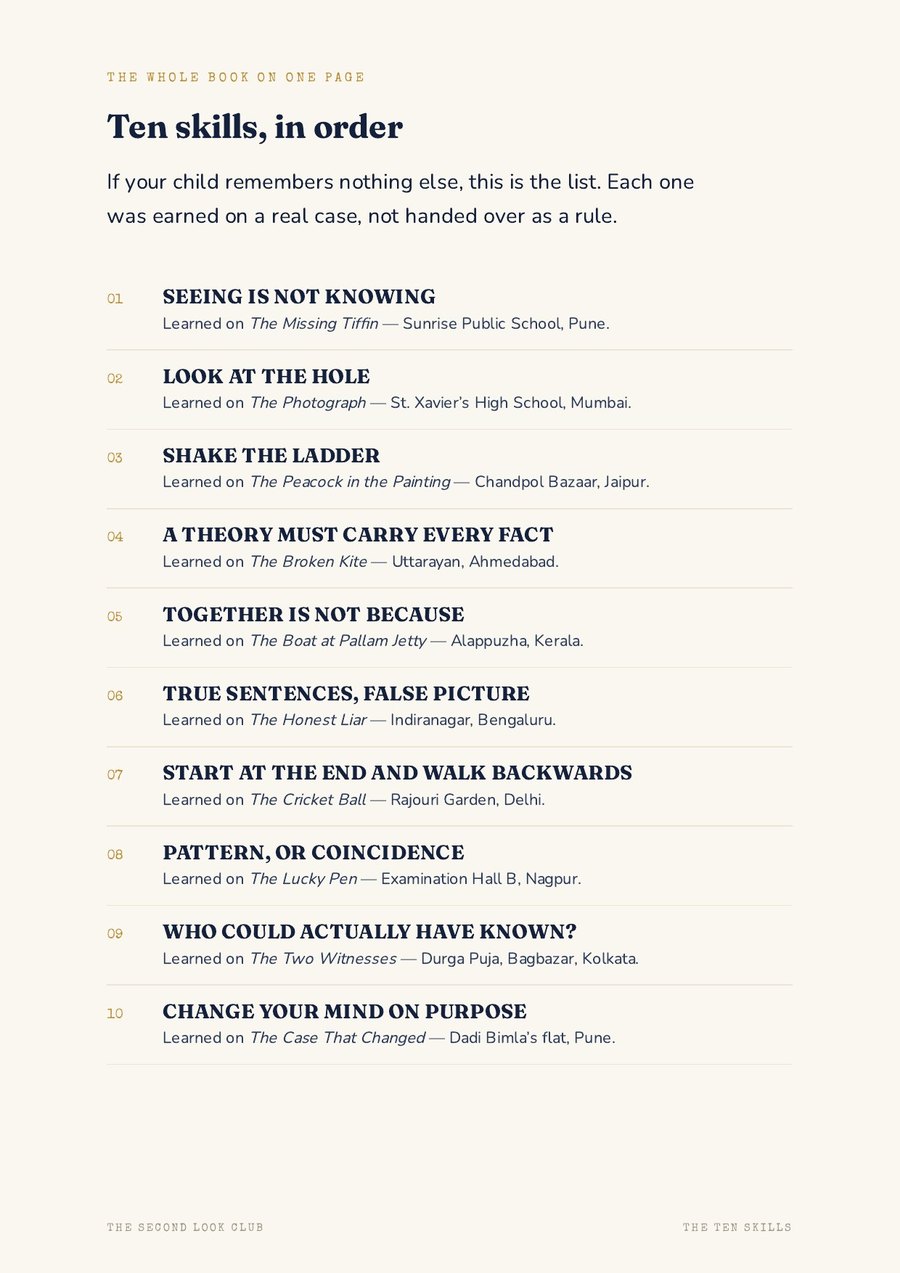
Ten cases. Ten named skills.
Each case isolates one thinking mistake — and gives the skill a name your child can use again. Each is set somewhere they recognise: a school corridor, a jetty in Kerala, an exam hall, a Durga Puja pandal.
- 01Seeing is not knowingThe Missing Tiffin · Sunrise Public School, Pune
- 02Look at the holeThe Photograph · St Xavier’s High School, Mumbai
- 03Shake the ladderThe Peacock in the Painting · Chandpol Bazaar, Jaipur
- 04A theory must carry every factThe Broken Kite · Uttarayan, Ahmedabad
- 05Together is not becauseThe Boat at Pallam Jetty · Alappuzha, Kerala
- 06True sentences, false pictureThe Honest Liar · Indiranagar, Bengaluru
- 07Start at the end and walk backwardsThe Cricket Ball · Rajouri Garden, Delhi
- 08Pattern, or coincidenceThe Lucky Pen · Examination Hall B, Nagpur
- 09Who could actually have known?The Two Witnesses · Durga Puja, Bagbazar, Kolkata
- 10Change your mind on purposeThe Case That Changed · Dadi Bimla’s flat, Pune
Case ten is the one that matters most. In it the detective uses every tool correctly, accuses an innocent woman, and has to apologise. A child who suspects everybody has not got cleverer — they have found a way to stop having to check.
What it looks like at home
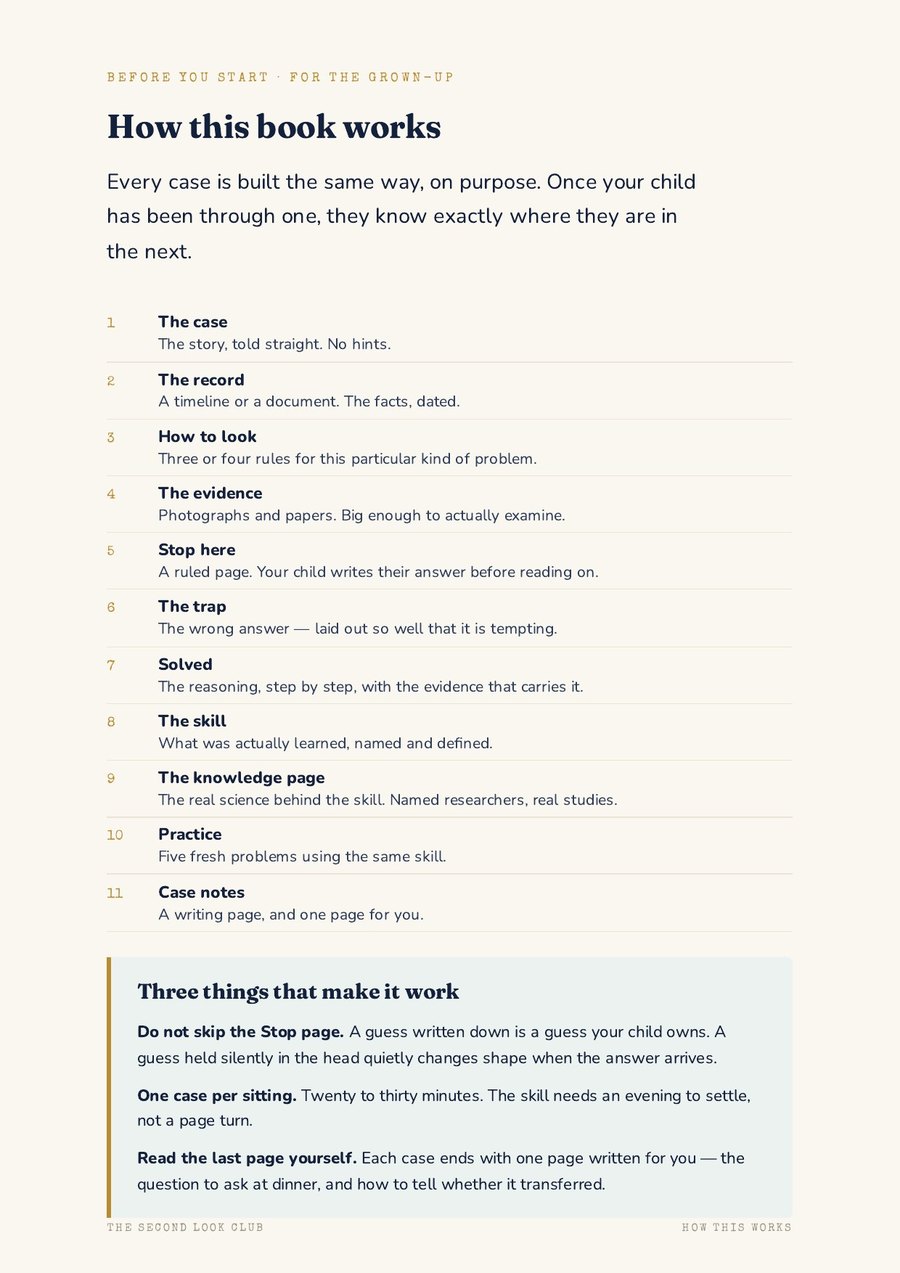
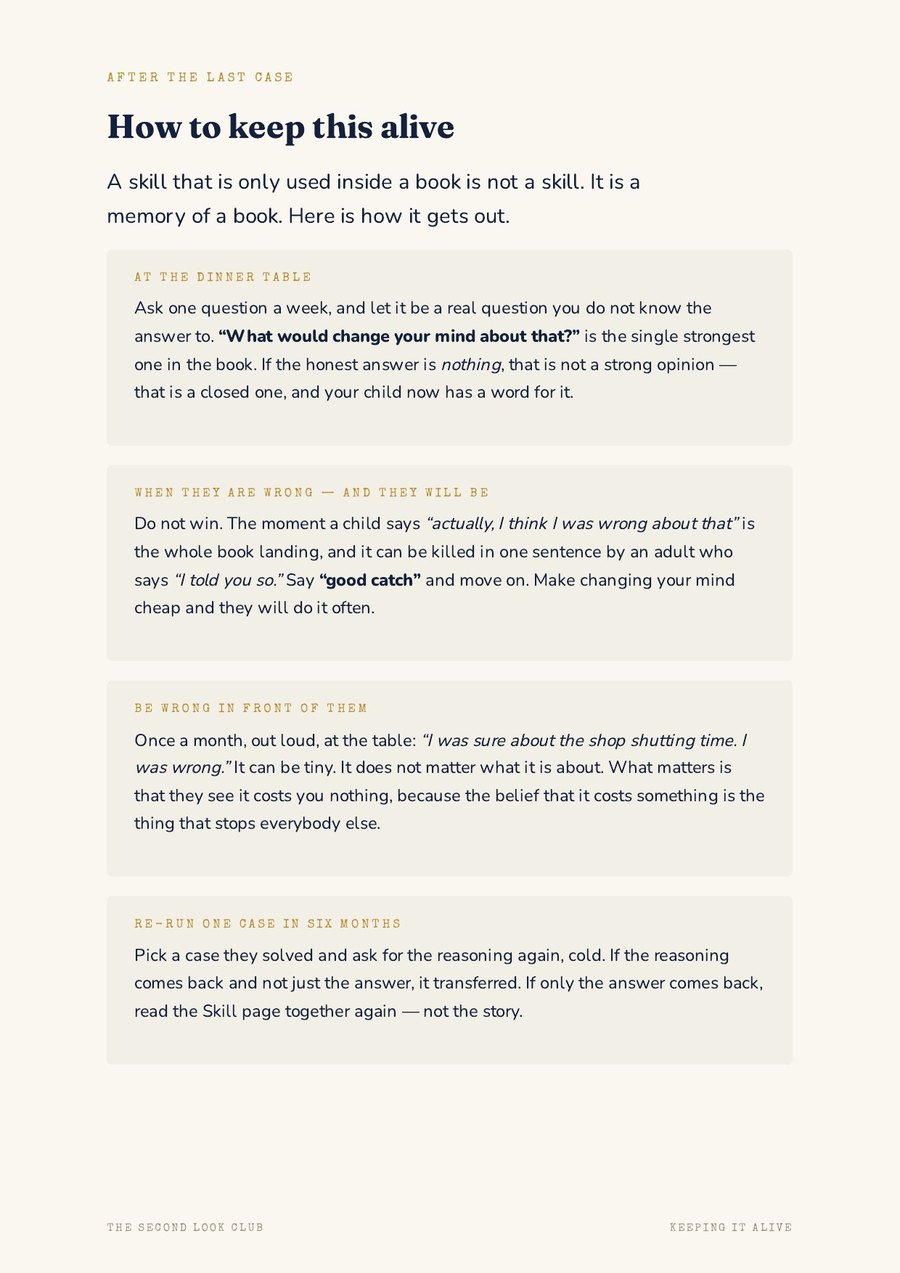
One case an evening. About two weeks.
You do not teach any of this. You print it, or you do not, and then you get out of the way.
Be honest with yourself here
This is not the right book for every child.
It works beautifully if…
- Your child is 7 to 12 and reads for pleasure, even a little
- They answer fast and confidently — and are sometimes wrong
- They believe things because somebody said them on a screen
- You want something they do alone, then want to talk to you about
- You would rather they argued with evidence than stopped arguing
Give it a miss if…
- You want worksheets to keep a child occupied — this asks for real attention
- Your child is under 7; you would be reading it to them, and the writing step is the point
- You want an app or a video — this is paper, deliberately
- You need a printed hardback posted to you. This is a file you print or read on screen
- You are after a confidence-booster — this one is built to be humbling first, and reassuring afterwards
Who wrote this
Why a mother who works in HR wrote a detective book for children.
I didn’t set out to write a children’s book.
I work in HR. Much of my job is judging people fairly, and one lesson comes back every week: the first story is rarely the whole story. Clever, experienced adults decide too quickly, trust the loudest voice, and miss what isn’t in the room.
As a mother, I wanted my child to learn that habit early, not at forty. So I turned it into a game. The book does not tell a child to think carefully — telling has never worked on anybody. It sets ten traps instead, and lets them walk into the first one early, where being wrong costs nothing but a pencil mark and a turned page.
You will know it is working on the day they ask you a question you cannot answer straight away.
In every order
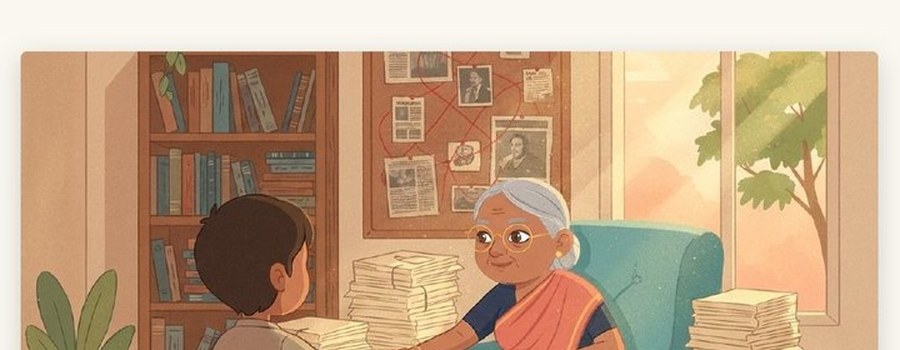
Four files. In your inbox in about a minute.
Nothing is posted, nothing takes three days, and nothing expires. The fourth one is for you.
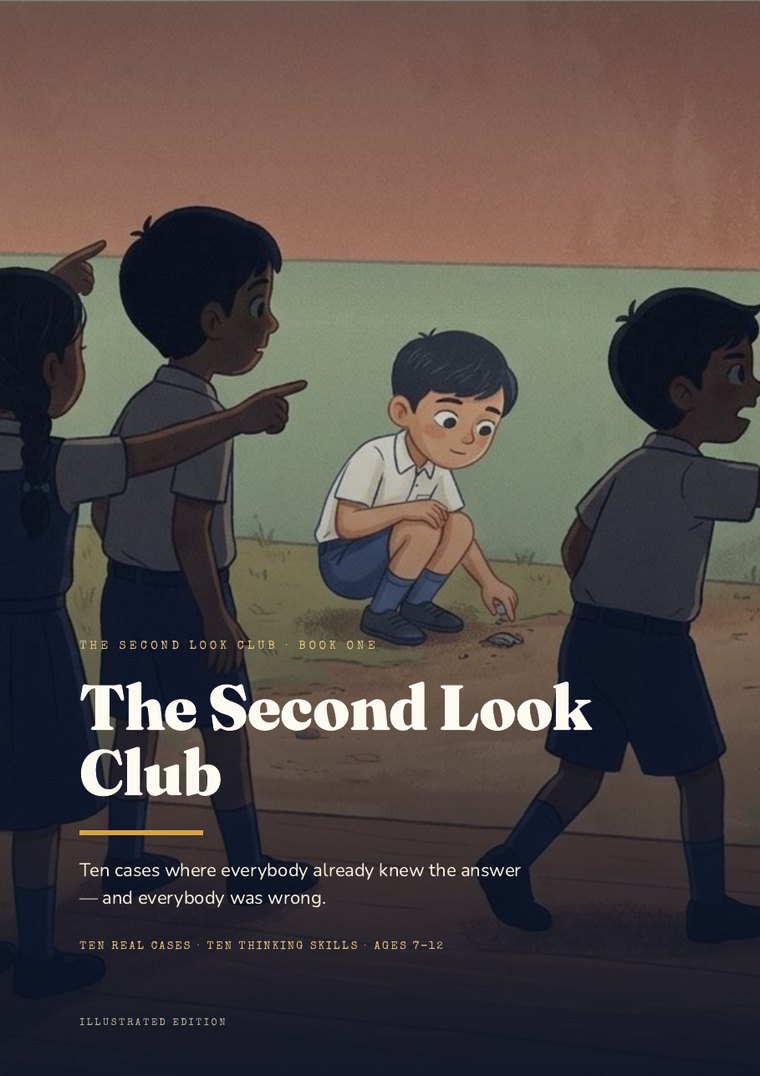
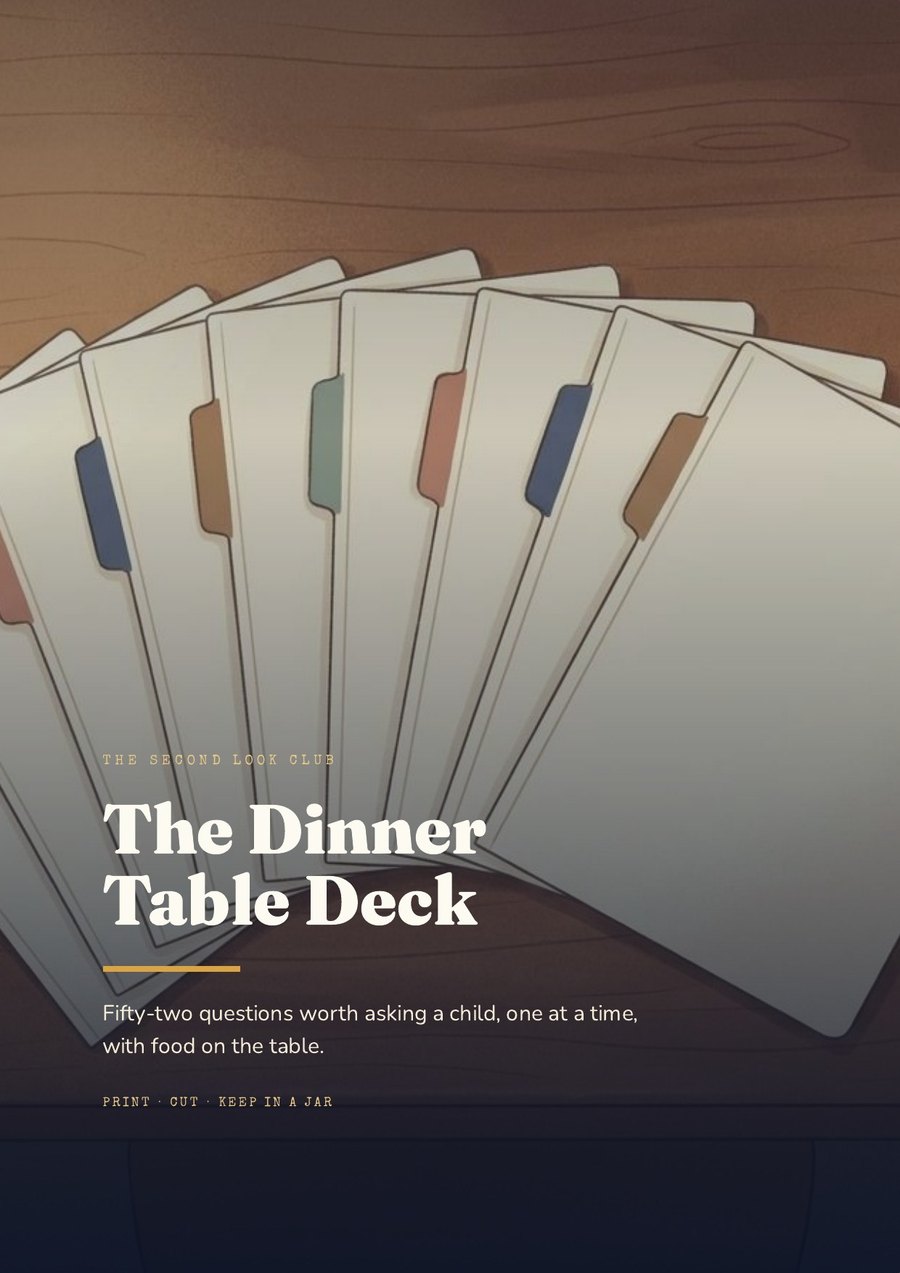
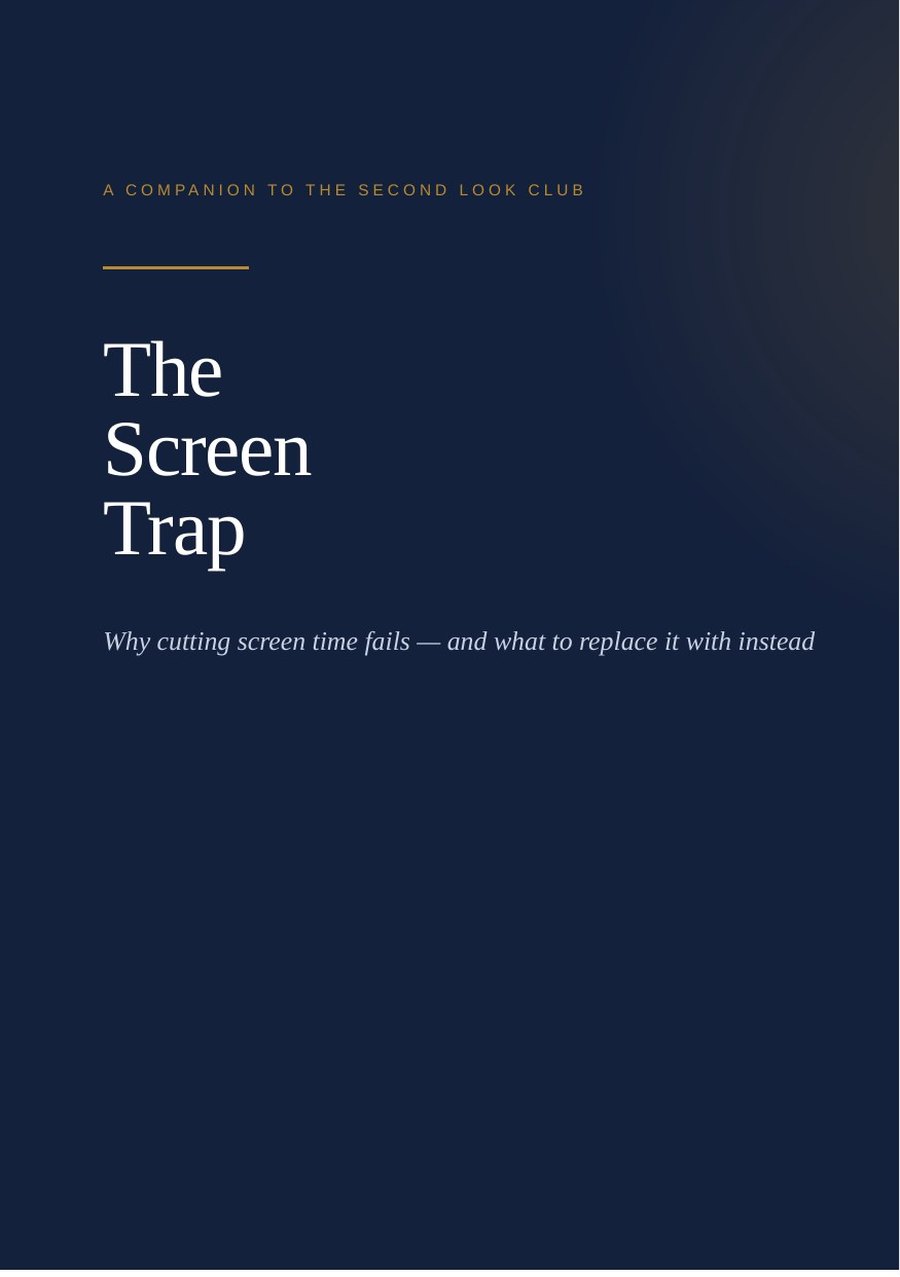
And inside the book itself
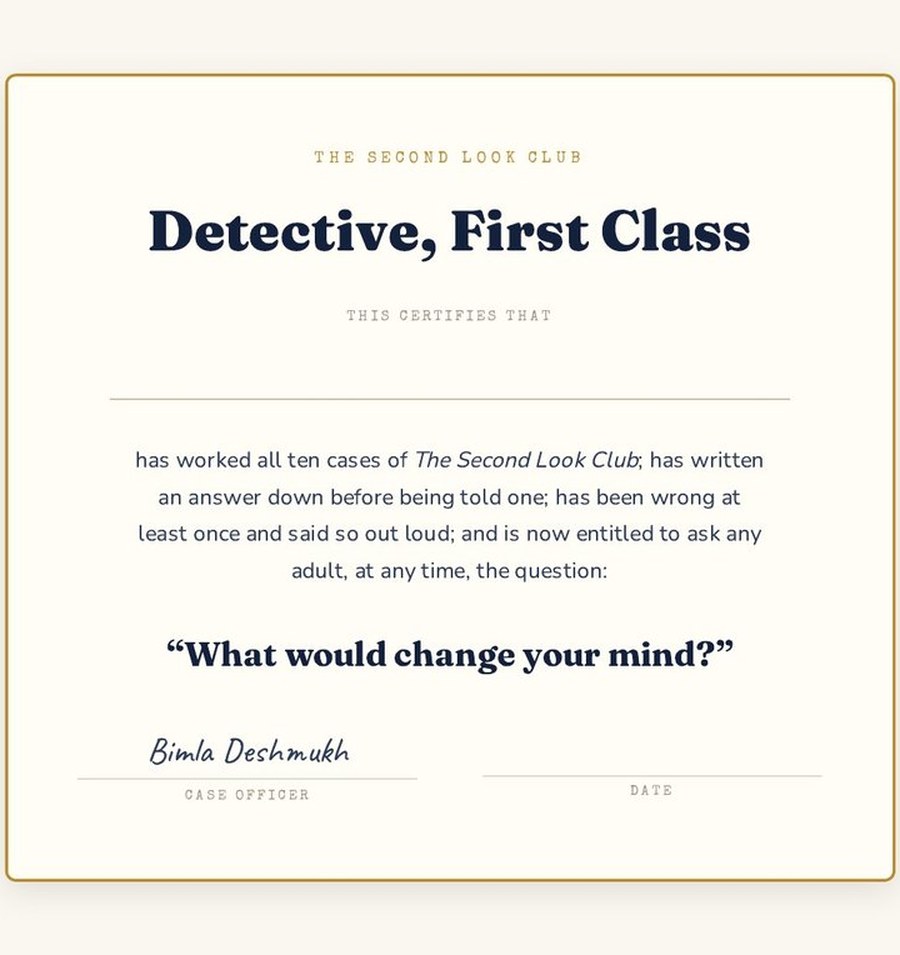
That is the whole package. It is in your inbox about a minute after you pay.
Nothing is posted. Nothing expires. If a file ever fails to download, we send it again.
The honest bit about price
₹425 for a file?
It is a fair question, and the comparison in your head is probably a paperback at the bookshop for ₹300. So here is the difference, plainly.
A paperback is read once.
This one is written in. The whole method depends on your child committing an answer in pen before the reveal — which means the copy they use gets used up.
So you get a printable edition you can run again. For the same child a year later, or for the next one. No second purchase.
What you are not paying for.
No printing, no warehouse, no courier, no bookshop margin. Nothing is posted and nothing can be delayed or lost.
The ₹149 Dinner Table Deck is in the price too, which is where a good part of the value sits once the book is finished.
Before you buy
Fair questions.
My child is 7. Or 12. Will it actually work?
It is written for 7 to 12, and the range is real rather than marketing. A confident seven-year-old reader will manage case one alone and may want company for the knowledge pages. A twelve-year-old will move faster and get caught by cases six through ten, which are the harder ones.
If your child is under 7, wait a year. The writing-it-down step is what makes the whole thing work, and it does not work if you are holding the pen.
Is this printed and posted to me?
No. It is a digital download, which is exactly why 167 illustrated pages cost ₹425 instead of what a colour-printed book would. The black-and-white edition is built so a home printer, or the shop downstairs, produces all 167 pages for roughly ₹250–400 — and you can print it again whenever you need to.
What if we do not like it?
There are no refunds on digital files — once it is downloaded it cannot be returned, and anyone promising otherwise is not being straight with you. What you get instead is a replacement, for as long as you own it: if a download fails or you lose the files, email from the address you bought with and they are sent again, as many times as you need.
That is also why every page above is a real page from the book. Look before you decide, rather than trusting a promise afterwards.
How much screen time does this add?
None, if you print it. That is rather the point — it is a book with a pencil, and the only screen involved is the one you are reading this on.
Do I need to sit with them?
No, and it works better if you do not. Each case is designed to be done alone, then talked about. The parent’s guide after each case gives you the one question worth asking at dinner, which is a far better use of you than reading over their shoulder.
Is there a second book?
Yes. Who Gains? is Case Files 02 — 179 pages about the people who want something from you: a free samosa that moves twenty-seven votes, a closing-down sale that has been closing down for five months, a video where every sentence is true and you still end up with the wrong water bottle.
Book one is about what you see. Book two is about who is telling you. You can add it at checkout for ₹374 instead of ₹424 — or ignore it entirely and come back later.
What language is it in?
English throughout, written plainly enough for a seven-year-old who reads for pleasure and not so plainly that a twelve-year-old feels talked down to.
The cases are Indian — a school corridor in Pune, a jetty in Kerala, an exam hall in Nagpur, a Durga Puja pandal in Kolkata. The names, the food and the arguments are ones your child already recognises.
How long will it last us?
About two weeks at one case an evening, and rather longer if you let a case sit for a day, which is how it is meant to be read.
After that the Dinner Table Deck is the part that keeps going — 52 cards, one at a meal, which is another few months of the same habit without another book. And because you can print the black-and-white edition again, a younger brother or sister can do the whole thing fresh in a year or two without buying anything.
How does it reach me?
The moment the payment goes through you land on a download page with every file on it, and the same links arrive by email. Card, UPI and netbanking all work, and the payment is handled by Razorpay.
One last thing
The best moment in this book is the one where your child is wrong.
You will not be there for it. They will be on the floor somewhere with a pencil, and they will turn a page, and their face will do something. That is the whole thing working.
167 pages · 98 illustrations · The Dinner Table Deck included · Files replaced free, for as long as you own them